Research

The assumption nobody has measured

Regulators and clinicians decide whether a medicine is acceptable at one point in pregnancy and not another. That judgement rests on the idea that the developing brain has windows of vulnerability which can be placed on a calendar. In human tissue, that idea has been inferred from population statistics — and the statistics do not hold still.

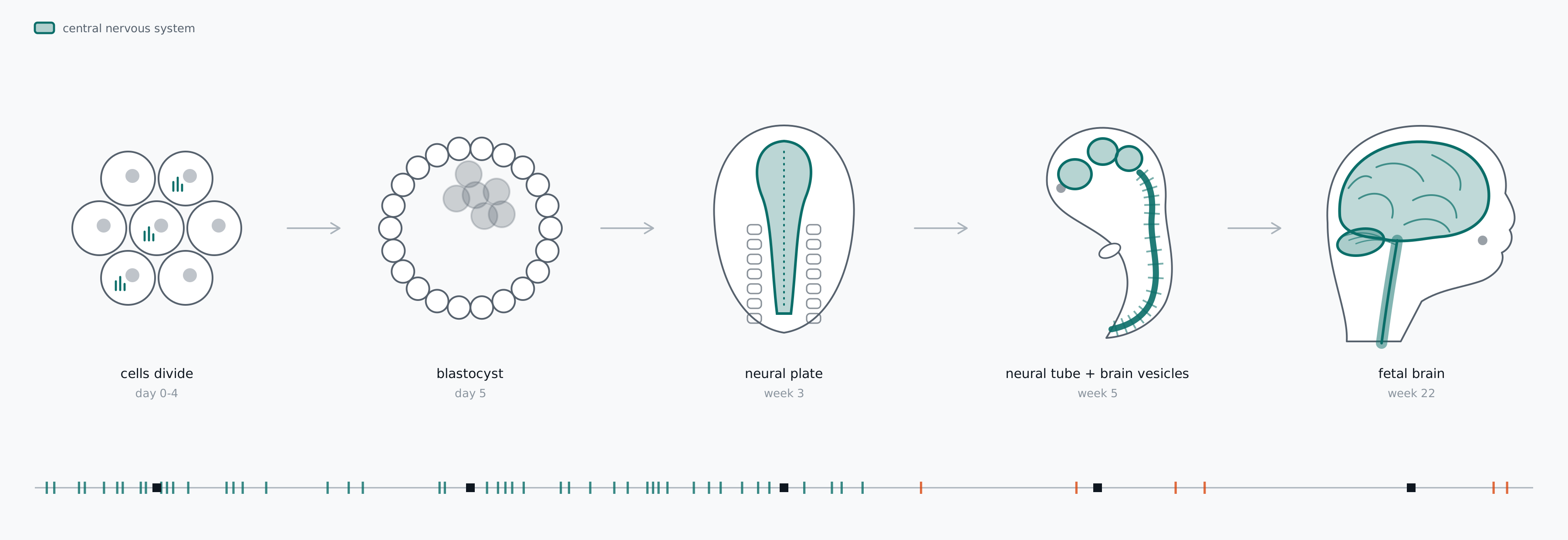
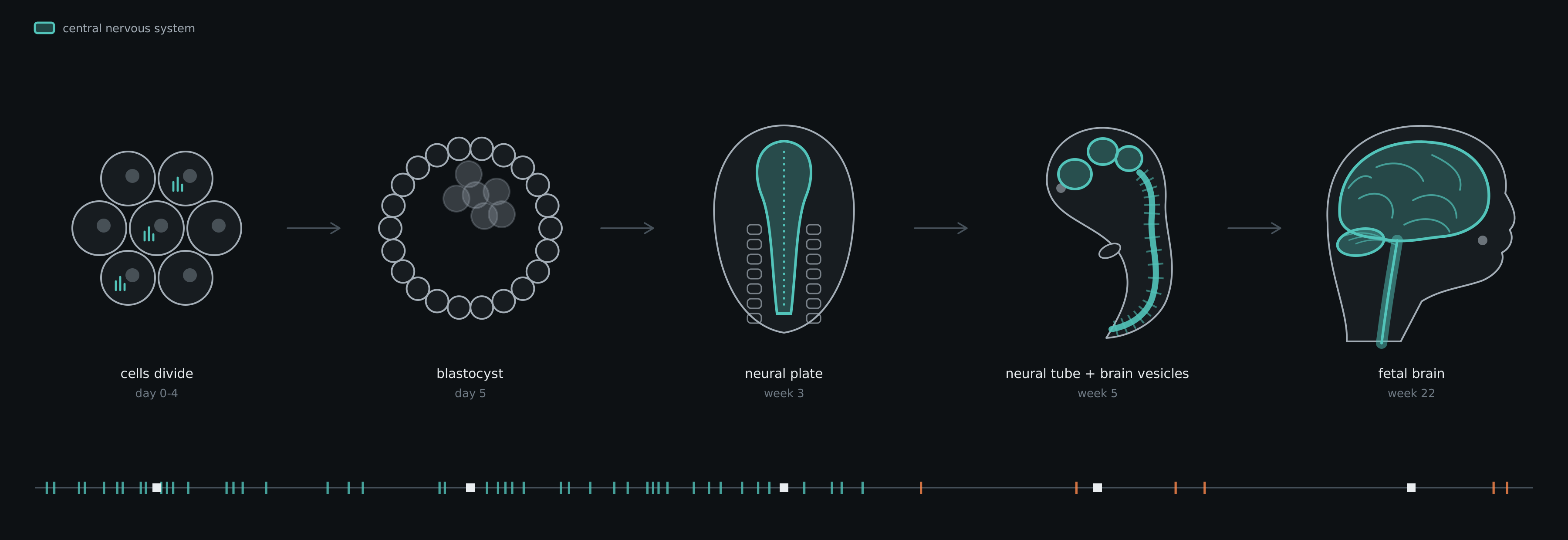
Five stages of human development, from the first divisions to a fetal brain: dividing cells, a blastocyst, the neural plate at week 3, an embryo with a neural tube and three brain vesicles at week 5, and a fetal brain at week 22. The central nervous system is shown in teal, above a timeline of recording marks that are dense early and rare later.
From one cell to a nervous system, in human development. The central nervous system is teal. The tape underneath is time: marks are dense early and rare later. Schematic drawing, not to scale.

Two results that should not both be true

Neither is a story about sloppy epidemiology. Exposure misclassification, confounding and low power are all real, and none of them is sufficient — because all three share a hidden premise: that gestational age was the right thing to measure.

Antenatal corticosteroids

Same drug, same week, opposite signals

These are dated to the day in national registries, which makes them the best-timed prenatal exposure in medicine. In a Finnish cohort of 670,097 children, treatment was associated with a 47% higher hazard of mental and behavioural disorders among children eventually born at term — and no excess hazard at all among those born preterm.

Organophosphate pesticides

An effect that will not stay still

In the Norwegian Mother, Father and Child Cohort Study, prenatal exposure measured at week 17 was associated with poorer preschool executive function, but not with diagnosed preschool ADHD. The exposure is real. The effect changes depending on what you ask.

The hypothesis

The developing cortex is not a synchronised clock.

Progenitor cells divide, differentiate and stop dividing on their own schedule. At a single gestational age, neighbouring families of cells occupy quite different molecular states. Cells carry their own developmental clock, and it runs independently of the calendar.

So: developmental vulnerability may be a property of transient cell states rather than of chronological time. If a chemical can only injure cells that are occupying a narrow, briefly held state, then the week of pregnancy predicts injury only as well as it predicts how many cells happen to be in that state. A sensitive window would then be the blurred shadow of an asynchronous cellular process, projected onto a calendar.

The competing explanation is the classical one, and it is strong: susceptibility may genuinely track developmental time, because the processes that matter — neurogenic peaks, migration — are themselves time-locked at the level of the whole tissue. The programme is built to separate the two quantitatively rather than to confirm the preferred answer.

What would settle it

The history of an individual human neural cell: which lineage produced it, which exposure-response programmes it ran, in what order, and what state it was in at the time.

No current method provides this. Epidemiology dates exposure at the level of a pregnancy. Single-cell atlases describe states without histories. Lineage recorders reconstruct ancestry but carry no exposure information. Organoid experiments average across a mixed population and cannot tell a cell that responded from an untouched neighbour beside it.

Why this is possible now

Three separate advances, none of them ours, that nobody has yet put together. The novelty is in the combination and in making it survive five months of culture — so the risk is combinatorial, not foundational.

Ordered molecular writing

Prime editing can insert short sequences into a repeated genomic array in a strictly ordered way, so the sequence of events — and therefore relative time — can be recovered from a single cell at the end of an experiment.

Signals that choose the symbol

Promoters that respond to a specific signal can drive that writing, so the mark recorded says which transcriptional programme was active. Dozens of channels have been multiplexed in published work.

Long-lived human tissue

Human forebrain organoids and assembloids sustain patterned neural tissue for months, containing the cell types the epidemiological outcomes actually implicate.

The analogy is a flight data recorder in the genome. Each time a defined cellular programme switches on, it writes a symbol onto an ordered tape. Reading the tape at the end returns, for every single cell, a compressed history of which programmes ran and in what order.

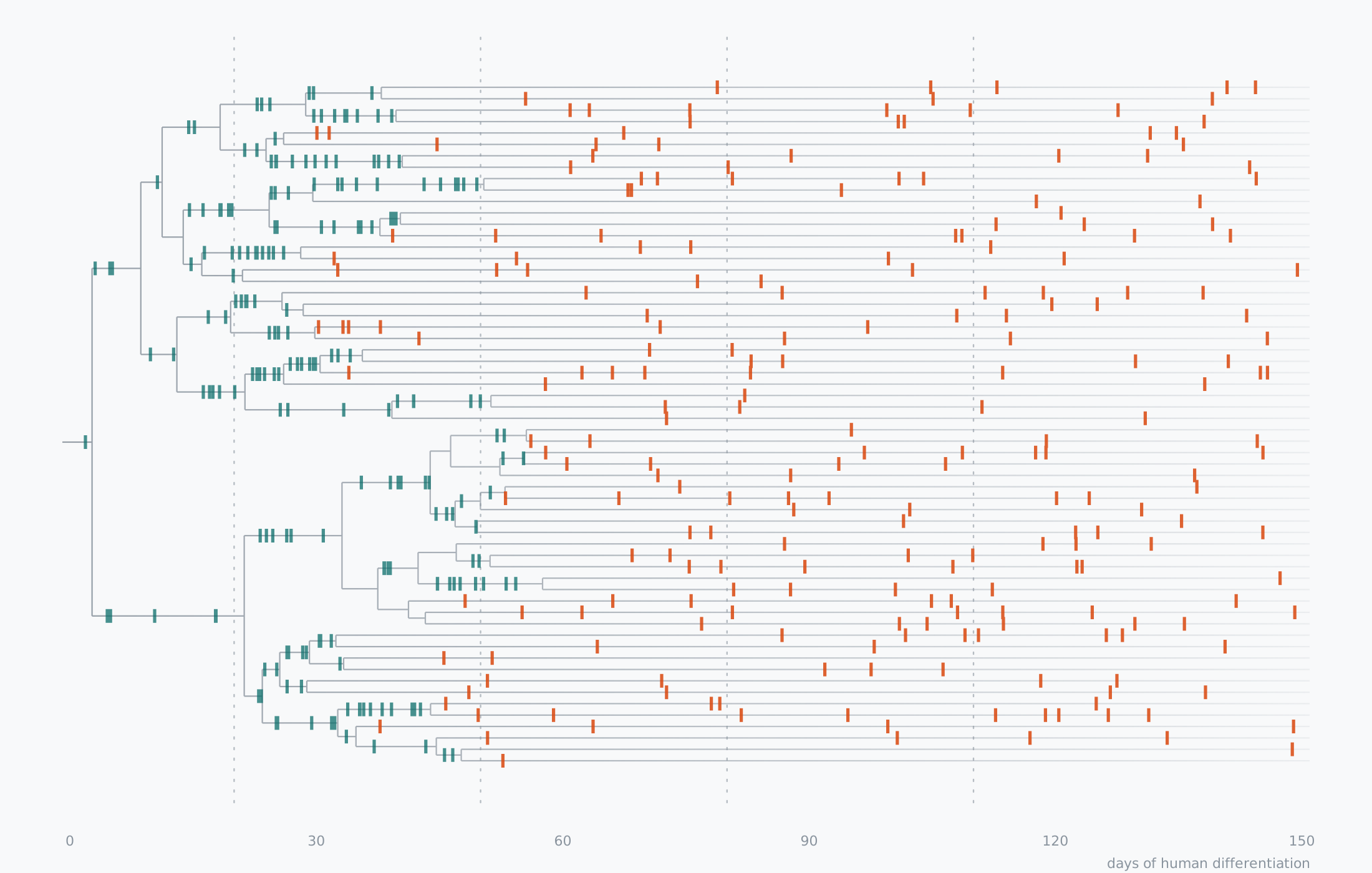
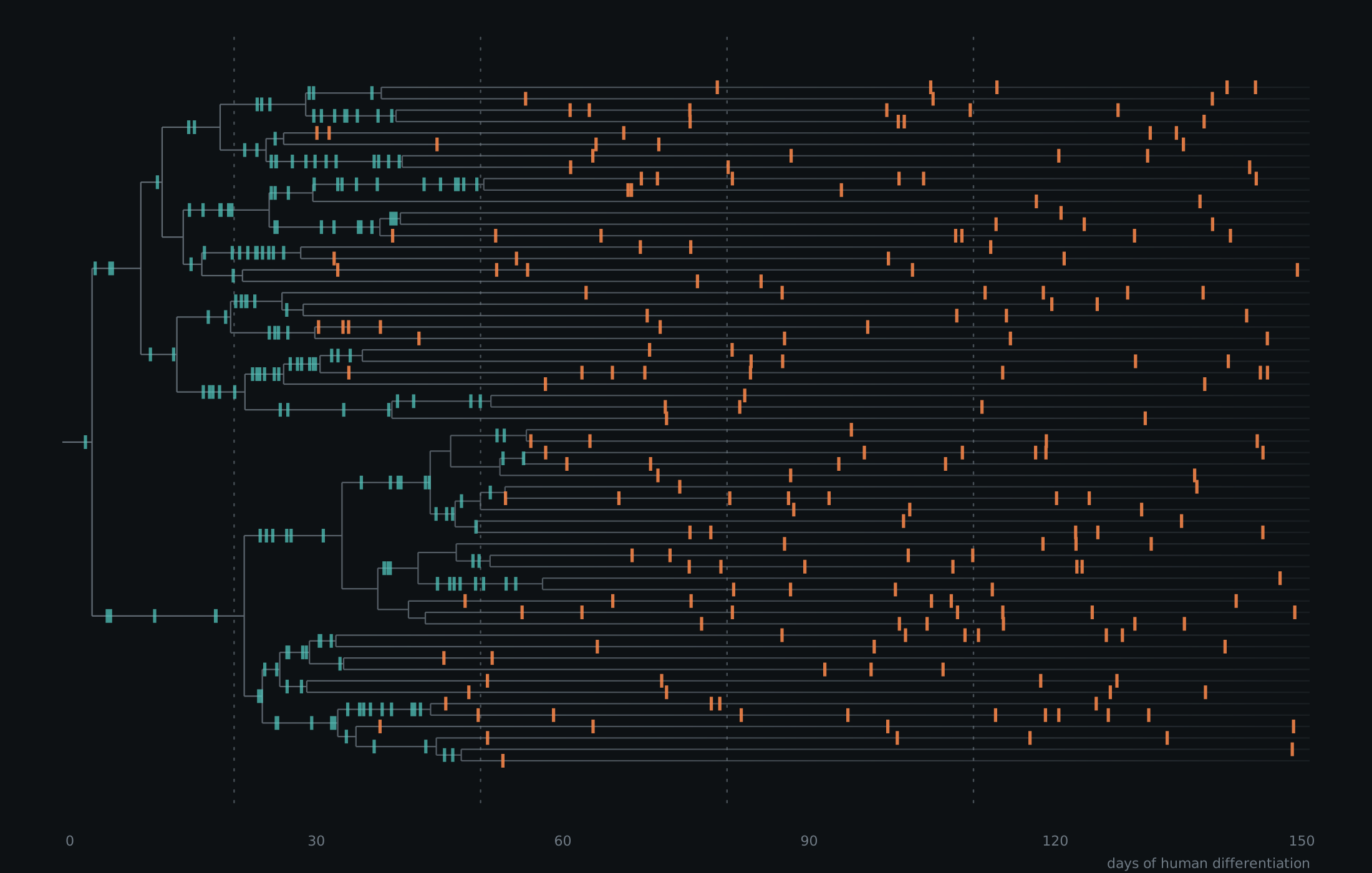
A simulated lineage tree. One progenitor cell divides into 60 cells over about 50 days. While a cell divides, it writes dense teal marks along its line. After it stops dividing, it writes only rare orange marks, for the rest of 150 days. Four dotted vertical lines mark example days on which a drug pulse is given.
What a record could look like. This is a simulation drawn from a simple model, not experimental data. One progenitor divides into 60 cells. Teal marks are written while a cell divides and orange marks after it stops. The dotted lines are four example days on which a drug pulse is given. Every cell stops at its own moment, so the calendar and the state of the cell drift apart.

Three aims, in order

Each aim decides whether the next one happens. The criteria below were fixed before any data were seen.

Aim 01 · Months 1–20

Write and calibrate a developmental record in human neural tissue

The recording substrate is a tandem array of prime-editing target sites placed at a safe-harbour locus with insulators either side. Three separately addressed channels each write their own symbol: a lineage channel that ticks with cell division at a deliberately low, tuned rate; a glucocorticoid channel; and a channel for xenobiotic and oxidative stress, the convergent consequence of low-dose organophosphate exposure.

Cassettes go into four well-characterised human iPSC lines from established biobanks, two female and two male. Clones are screened for copy number, integration site, expression stability, karyotype, pluripotency and unchanged differentiation against the parent line.

The test
Organoids receive synthetic glucocorticoid pulses on a schedule I set. The question is simply whether the record gives the schedule back.
Honest limit
Insulation reduces silencing but does not guarantee expression over months of differentiation, so stability is established empirically rather than assumed.
If it fails
The programme continues with the validated lineage channel plus the best exposure channel. That preserves the central comparison at reduced multiplexing and delays Aim 2 by no more than a quarter.

Go / no-go thresholds, fixed in advance

  • Sensitivity — at least half of receptor-expressing cells record a single 24-hour pulse
  • Temporal resolution — two pulses ten days apart correctly ordered in at least 80% of recording cells
  • Dynamic range — at least eightfold between stimulated and unstimulated writing
  • False positives — below 5% per channel per 30 days in vehicle-treated tissue
  • Persistence — demonstrable writing still happening at day 150

Aim 02 · Months 13–48

Calendar time, or cell state?

Two exposures, deliberately contrasted, and no others. A synthetic glucocorticoid is the calibration case: its receptor is a ligand-activated transcription factor that can be wired straight into a channel, dosing can be scheduled to the hour, and its clinical timing is documented to the day in national registries. It is the only prenatal exposure for which a genuine timing ground truth exists.

An organophosphate, delivered as its active metabolite, is the application case: chronic, dietary, low-dose and undatable in humans, with an inconsistent epidemiological signal that the state hypothesis would explain, and with live regulatory attention on it.

The comparison
A time-indexed and a state-indexed model, compared on out-of-sample predictive performance in the same cells, with lineage and cell type held constant.
Dose realism
Concentrations come from physiologically based kinetic reverse dosimetry against measured maternal biomarker distributions, targeting the median and ninetieth percentile of real human internal dose.
What organoids are not asked to do
They are not asked to model systemic pharmacokinetics. Maternal metabolism, placental transport and fetal clearance are handled upstream in the kinetic model.

Where this comes from in our own work

Aim 03

Is the susceptible state causal, or only a marker?

A state that merely correlates with damage is interesting. A state that causes it is actionable. The test is an asymmetry: intervening while cells are in the identified state should reduce the exposure-associated phenotype, and the identical intervention outside that state should not.

Normal differentiation, cell-type proportions and survival all have to be preserved — otherwise the intervention has simply broken the tissue in a different way, which is a failure mode worth naming in advance.

Readout across all three aims

  • The record itselfTargeted amplicon sequencing, long-read for full arrays
  • StateJoint transcriptome and chromatin accessibility, from the same barcoded cell as the record
  • PositionTargeted in situ sequencing on sections
  • Behaviour over timeSparse fluorescent labelling for long-term live imaging

Open science

Reconstruction, symbol calling and error modelling build on published frameworks adapted to the multi-channel case. A simulation-based benchmark of reconstruction accuracy is released alongside the data, so the power calculations behind the design can be inspected rather than taken on trust.

The simulator behind our own preprint on the limits of molecular recording, along with its code and results, is released openly for the same reason: the design should not depend on an optimistic assumption that nobody else can check.

What I have not done before

Two capabilities this work needs are new to me: prime-editing recorder chemistry, and single-cell statistical modelling at scale. Saying so is more useful than implying otherwise.

The design answers it in three ways. The recorder work is front-loaded, with channel and locus design fixed from reporter data before any line is engineered. The central comparison is specified to succeed across the published range of editing and recovery rates rather than at one hoped-for value. And the computational load is a dedicated postdoctoral post with a named bioinformatics allocation beside it, not an extra duty bolted onto a bench scientist.